2014 Quarter Value Chart at a Glance
For a complete step-by-step breakdown of how to identify and grade each 2014 ATB quarter, see this in-depth 2014 quarter identification guide and reference. The table below summarizes typical retail values for all five designs across the main condition tiers. The gold-highlighted row is our signature variety (Everglades); the orange row is the highest condition-rarity (Arches Denver).
| Design / Mint | Circulated | MS60–MS65 | MS66–MS67 | MS68+ | S Clad Proof | S Silver Proof |
|---|---|---|---|---|---|---|
| Great Smoky Mtns (P) | $0.25 | $1 – $4 | $5 – $20 | $500 – $779+ | — | — |
| Great Smoky Mtns (D) | $0.25 | $1 – $4 | $5 – $20 | $500 – $700+ | — | — |
| Great Smoky Mtns (S) | $0.25 | $1 – $9 | $5 – $20 | Rare | $6 – $30 | $10 – $25 |
| Shenandoah (P) | $0.25 | $1 – $3 | $5 – $42 | $500 – $1,020 | — | — |
| Shenandoah (D) | $0.25 | $1 – $3 | $5 – $28 | $500 – $800 | — | — |
| Shenandoah (S) | $0.25 | $1 – $10 | $5 – $25 | Rare | $6 – $30 | $10 – $25 |
| Arches (D) ⭐ Most Condition-Rare | $0.25 | $1 – $3 | $5 – $30 | $200 – $4,500 | — | — |
| Arches (P) | $0.25 | $1 – $3 | $5 – $25 | $500 – $2,000 | — | — |
| Arches (S) | $0.25 | $1 – $6 | $5 – $20 | Rare | $6 – $30 | $10 – $25 |
| Great Sand Dunes (P) | $0.25 | $1 – $3 | $5 – $20 | $500 – $1,500 | — | — |
| Great Sand Dunes (D) | $0.25 | $1 – $3 | $5 – $20 | $500 – $1,500 | — | — |
| Great Sand Dunes (S) | $0.25 | $1 – $15 | $5 – $25 | Rare | $6 – $30 | $10 – $25 |
| Everglades (D) 🏆 Top Record | $0.25 | $1 – $13 | $5 – $30 | $1,000 – $5,995 | — | — |
| Everglades (P) | $0.25 | $1 – $3 | $5 – $25 | $500 – $2,000 | — | — |
| Everglades (S) | $0.25 | $1 – $11 | $5 – $25 | $675 – $2,095 | $6 – $30 | $10 – $25 |
📱 CoinKnow lets you snap a photo and cross-check estimated value against recent market data on the go — a coin identifier and value app.
What's on This Page
Valuable 2014 Quarter Errors (Complete Guide)
Five major error categories drive collector premiums on 2014 America the Beautiful quarters. Modern high-precision minting has eliminated most die variety issues, but mechanical errors during striking still reach circulation. Each error below has documented auction records, clear visual diagnostics, and specific details to help you determine whether your coin qualifies.
2014 Quarter Clipped Planchet Error
TOP SELLER $50 – $800+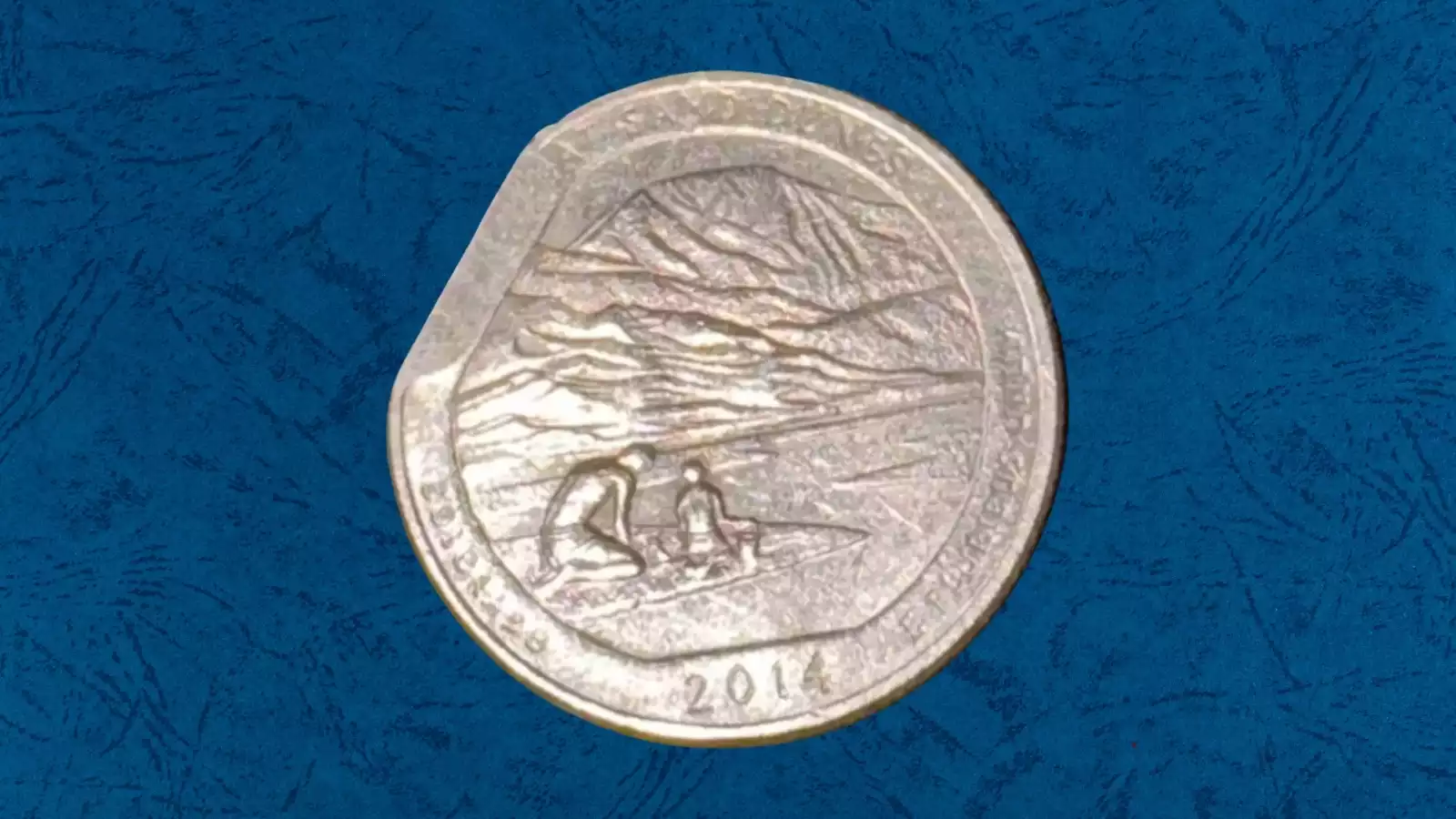
A clipped planchet error occurs when the coin blank (planchet) is punched out of a metal strip that still had a hole from a previously punched blank. The punch overlaps the earlier hole, removing a crescent-shaped or straight-edged wedge from the new planchet before it is ever struck. The error is entirely a pre-strike planchet issue, entirely unrelated to die condition.
Visually, look for a smooth, curved (oval clip) or straight edge replacing part of the normal reeded rim. Under a loupe, you will see the reeding simply ends or is absent in the clipped area, with the surrounding metal curving inward. A straight-end clip creates a flat chord across the rim, while a curved clip follows the arc of the prior blank hole.
Collector demand for clipped planchets is strong because the error is immediately evident, visually compelling, and straightforward to authenticate. The percentage of metal removed drives value: a minor 5% clip commands modest premiums, while a dramatic 15% or larger clip — like the 2014-P Shenandoah AU58 example that sold for $800 at Heritage Auctions in 2016 — commands the highest tier. Size, grade, and design all factor into final price.
2014 Quarter Broadstrike Error
MOST DRAMATIC $15 – $525+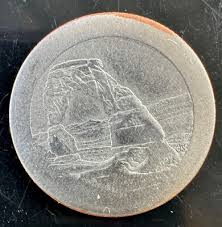
A broadstrike error occurs when the planchet is struck by the dies while outside its retaining collar — the hardened steel ring that surrounds the planchet during striking to contain the metal and impart the reeded edge. Without the collar, the metal flows outward freely, producing a coin with a larger-than-normal diameter, flatter-than-normal thickness, and a perfectly smooth edge with no reeding at all.
Diagnostics are immediate: a normal clad quarter measures 24.3 mm in diameter, while a broadstruck example will measure 26–28 mm or more depending on striking pressure. The design is compressed outward and may appear stretched, but the date and major devices are typically still fully visible. The edge is completely plain — run a fingernail around the rim and you will feel no reeding whatsoever.
Broadstrikes are among the most collectible modern error types because they are visually undeniable and easy to authenticate — there is nothing subtle about a coin that is a full 10% wider than it should be. A 2014-P Great Smoky Mountains broadstrike graded MS60 sold for $525 at Great Collections in 2018, placing it in the upper tier of 2014 error values. Collectors prize dramatic examples where the original design is still bold and centered despite the expansion.
2014 Quarter Missing Clad Layer Error
MOST VISIBLE $10 – $300+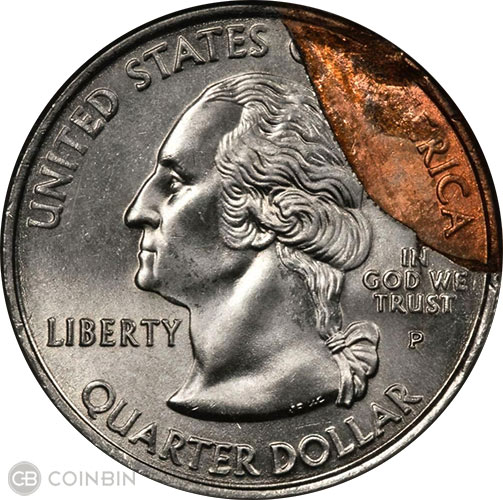
The modern clad quarter consists of an inner core of pure copper bonded between two outer layers of 75% copper / 25% nickel alloy — the latter giving the coin its characteristic silver color. When a planchet is fed into the press without one of its bonded outer layers, the exposed copper core is visible on the affected side. This is a pre-strike lamination or separation failure, not a post-mint alteration.
Recognition is immediate and color-based: the normal side looks standard silver-tone, while the missing-clad side appears distinctly orange-red or copper-brown. The design is struck normally on both sides — only the surface coloring changes. Under magnification, the surface of the missing-clad side will be slightly rougher than a normal nickel surface, reflecting the softer copper alloy beneath. The coin will also weigh slightly less than the standard 5.67 grams.
The Great Sand Dunes D-mint has the most-documented missing-clad example, with known instances affecting both sides simultaneously — an especially rare and striking presentation. Values range widely: a minor single-side missing layer might bring $10–$50, while a dramatic full-side example or double-missing instance can exceed $300. Certification is strongly recommended, as altered coins with acetone-treated surfaces are sometimes misrepresented as missing-clad errors.
2014 Quarter Off-Center Strike Error
MOST COMMON ERROR $20 – $320+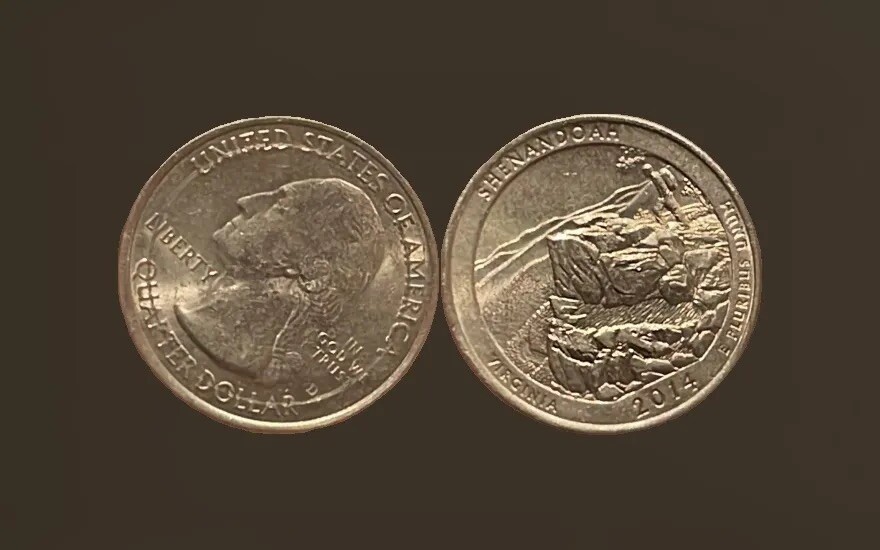
Off-center strikes occur when the planchet is not properly centered beneath the dies at the moment of striking. The result is a coin where the design impression covers only part of the coin's surface, with the remaining area appearing as a blank planchet surface. The degree of misalignment is expressed as a percentage: a 10% off-center strike shows 10% of the coin as blank, while a 50% example shows the design on one half and blank metal on the other.
The single most important diagnostic for collector value is whether the full date and mint mark remain visible on the offset design portion. A dramatic 40–60% off-center strike with a fully readable date is the most desirable configuration — dramatic visual impact, but the coin's identity is still confirmable. Minor 5–10% off-center strikes are common and carry modest premiums only. Look for the blank area to be smooth planchet metal, not damaged or filed, which would indicate post-mint alteration.
Off-center strikes are documented across all five 2014 park designs and at both P and D mints. The 2014-P Great Smoky Mountains quarter graded MS64 with an off-center error sold at online auction in 2015 for $320 — the benchmark for the best-grade examples. Entry-level 10–20% off-center pieces regularly sell in the $20–$40 range, making this the most accessible 2014 quarter error type for new collectors seeking genuine mint errors at low cost.
2014 Quarter Die Rotation Error
BEST KEPT SECRET $50 – $475+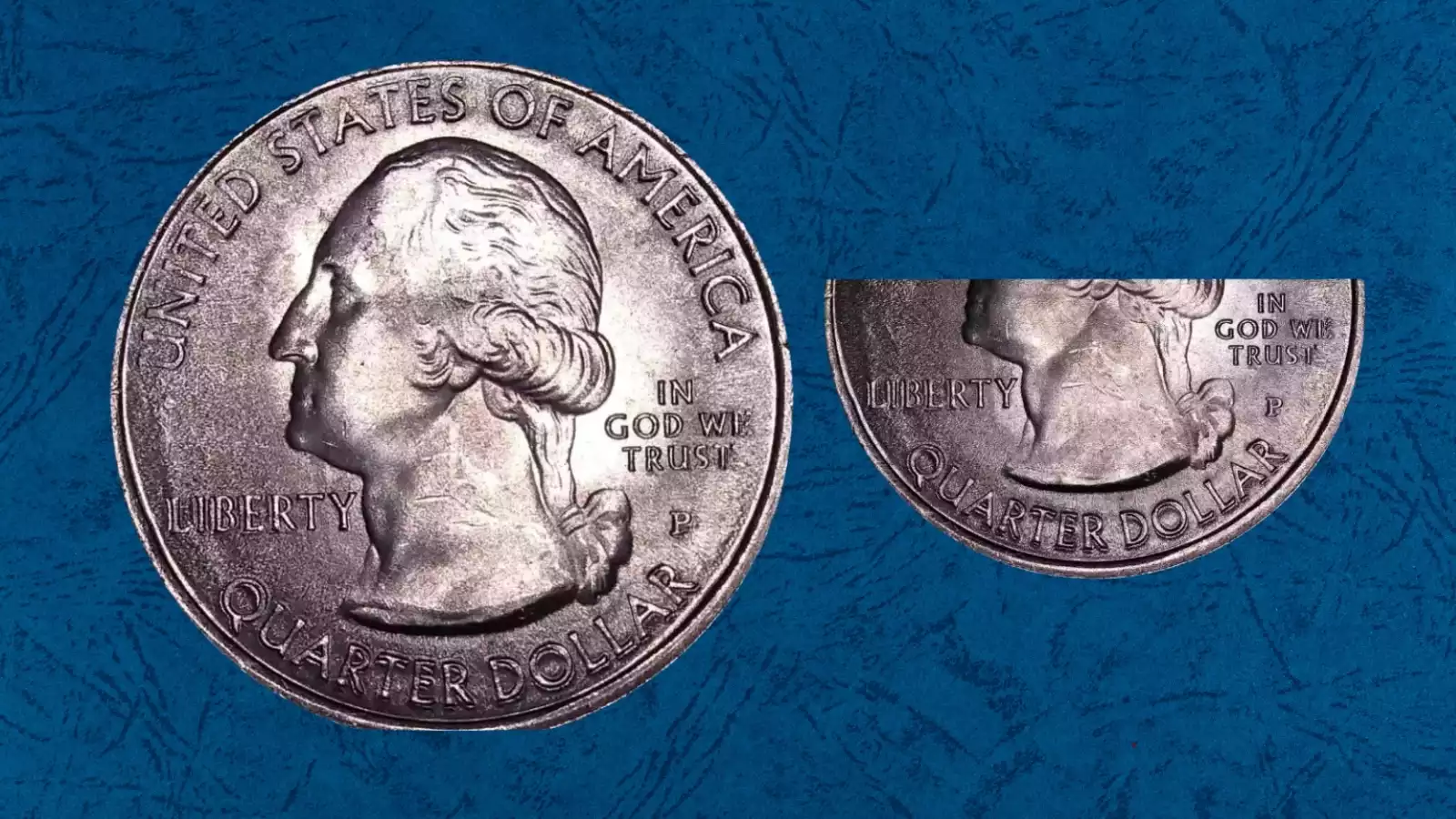
U.S. quarters are struck "coin turn" — meaning the reverse is rotated exactly 180° relative to the obverse. When the reverse die is improperly set or works loose in its seat during production, successive strikes produce coins where the reverse design is rotated by a measurable degree other than 180°. A 90° rotation error means the reverse is oriented perpendicular to the obverse; a 180° error (full reverse rotation) makes both sides appear the same orientation when held upright.
Measuring die rotation is straightforward: hold the coin by the edge with Washington's portrait upright, then flip the coin end-to-end (left thumb to right thumb, rotating on the vertical axis). On a normal coin, the reverse park design will appear upright after the flip. On a rotated example, the reverse will appear tilted or fully upside down. The degree of rotation determines collectibility; errors exceeding 45° are considered significant, and those exceeding 90° command the highest collector premiums.
The 2014-D Great Sand Dunes quarter graded MS60 with a documented die rotation error sold for $475 at Heritage Auctions in 2015, establishing this as one of the more valuable mechanical error types in the series. Unlike broadstrikes or clipped planchets which affect coin dimensions, die rotation errors leave the coin at standard size and weight — making them harder to detect without careful measurement, which partly explains why they are sometimes called the "best kept secret" among 2014 quarter errors.
Think you've spotted one of these errors?
Use the free calculator below to get a value estimate based on your specific design, mint, and condition.
2014 Quarter Mintage & Survival Data
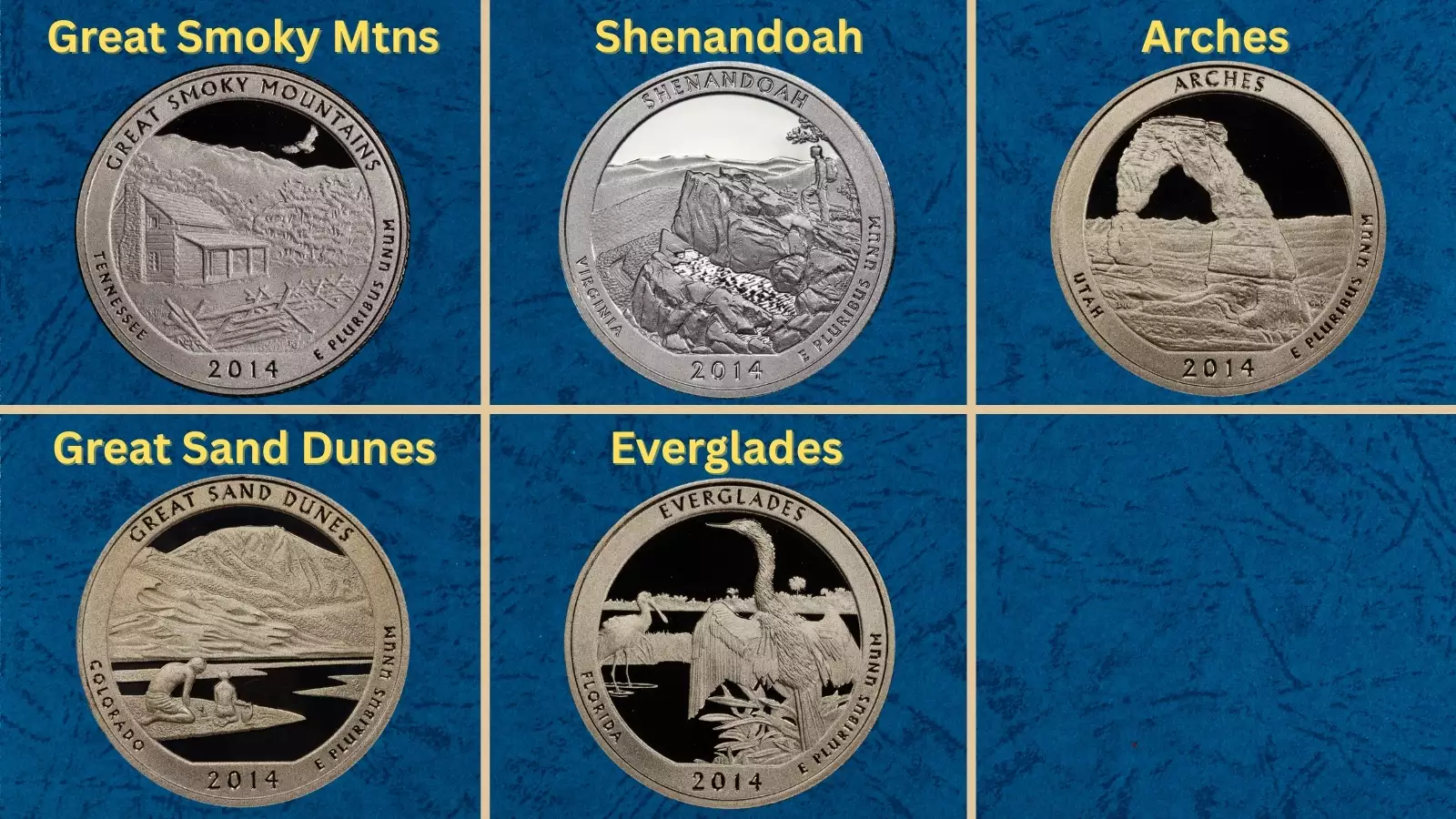
| Design (State) | Philadelphia (P) | Denver (D) | S Unc. | S Clad Proof | S Silver Proof | Combined Circ. |
|---|---|---|---|---|---|---|
| Great Smoky Mountains (TN) | 73,200,000 | 99,400,000 | 1,360,780 | 828,186 | 586,325 | 172,600,000 |
| Shenandoah (VA) | 112,800,000 | 197,800,000 | 1,239,320 | 828,186 | 586,325 | 310,600,000 |
| Arches (UT) | 214,200,000 | 251,400,000 | 1,203,100 | 828,186 | 586,325 | 465,600,000 |
| Great Sand Dunes (CO) | 159,600,000 | 171,800,000 | 1,146,000 | 828,186 | 586,325 | 331,400,000 |
| Everglades (FL) | 157,601,200 | 142,400,000 | 1,139,140 | 828,186 | 586,325 | 300,001,200 |
| TOTAL 2014 | 717,401,200 | 862,800,000 | 6,088,340 | 4,140,930 | 2,931,625 | 1,580,201,200 |
Survival notes: Despite over 1.58 billion coins struck, the MS68+ population for each design is in the single to low double digits at PCGS and NGC combined. The jump from MS67 to MS68 represents the critical value threshold — most coins accumulate bag marks in mint bags before ever reaching collectors. Great Smoky Mountains (P) has the scarcest certified MS68 population; Arches (D) is ranked the most condition-rare in the entire 56-coin ATB program.
How to Grade Your 2014 Quarter
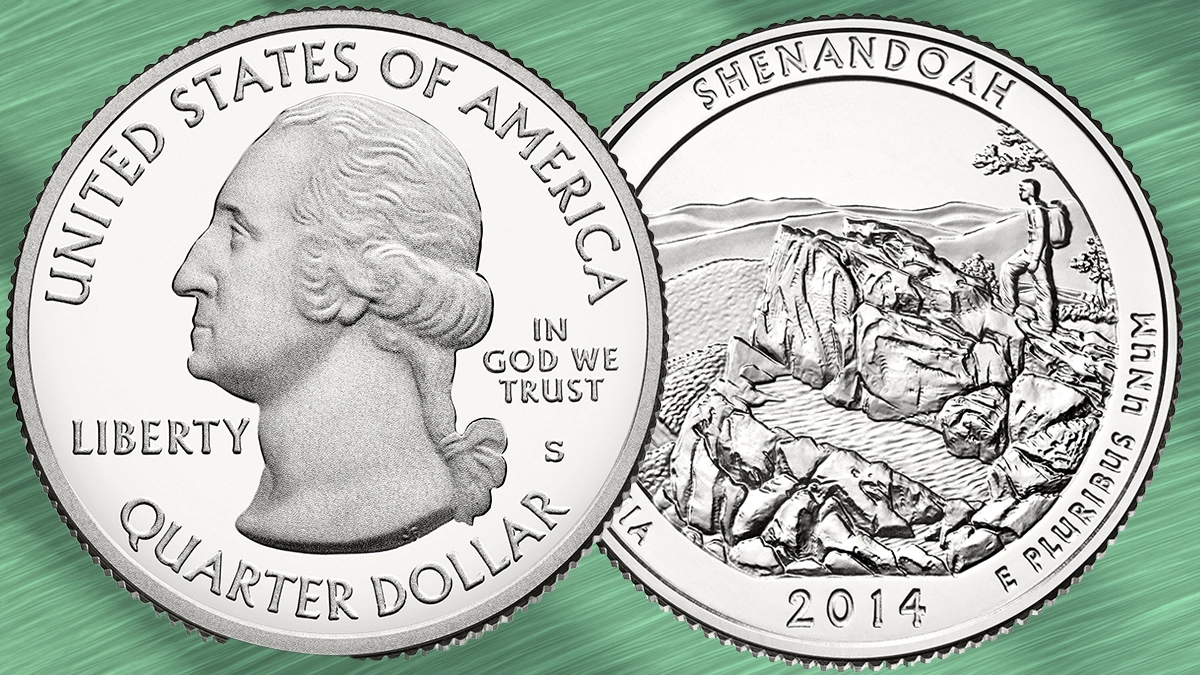
Worn
Washington's portrait is flat with little hair or facial detail. On the reverse, the park design is soft and poorly defined. No mint luster remains. All 2014 quarters in this grade are worth face value ($0.25) — the coin is essentially a spendable quarter.
Circulated
Major design elements are visible but Washington's cheekbone and the hair above his ear show wear. On the reverse, the eagle's breast or park-scene high points are flattened. Some mint luster survives in protected areas (AU). Still worth face value to perhaps $1 for most 2014 quarters.
Uncirculated
No wear anywhere — full mint luster present. However, bag marks from mint packaging reduce the grade below MS65. The open fields around Washington's portrait are the most critical surfaces; even a few tiny contact marks in those areas cap the grade at MS63. Value: $1–$4 for most designs.
Gem / Registry Grade
Virtually mark-free surfaces with blazing cartwheel luster. MS68 requires surfaces that are essentially clean under 5× magnification — population counts are in the single digits for many designs. This is where values multiply: MS68 = $500–$4,500; MS69 = up to $5,995. Professional grading at PCGS or NGC is essential at this tier.
🔎 CoinKnow can match your coin's surfaces against graded examples to help you gauge condition before submitting for certification — a coin identifier and value app.
2014-D Everglades Quarter Self-Checker
The 2014-D Everglades holds the all-time record for the series at $5,995 in MS69. Use this checklist to assess whether your coin shows the key characteristics that attract Registry Set premiums.
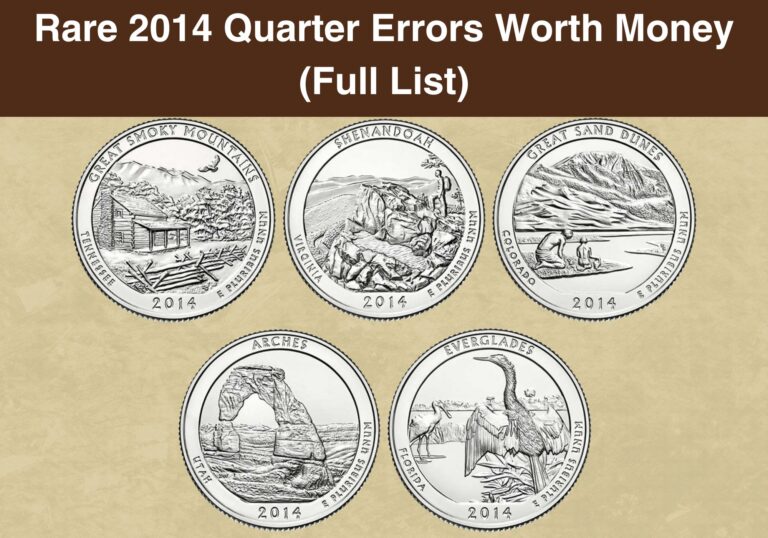
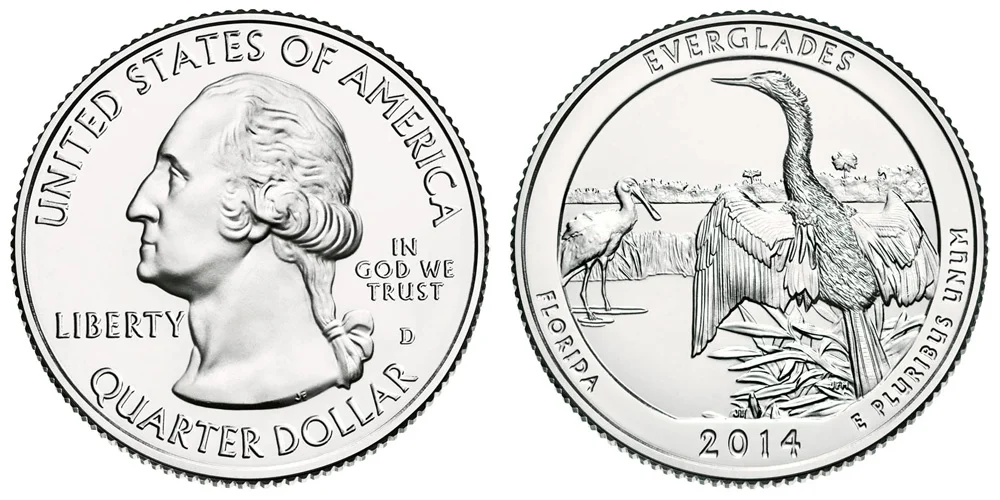
⚠️ Common MS63–MS65 Example
- Several bag marks visible in the obverse fields
- Contact marks on Washington's cheek or jaw
- Luster present but not blazing cartwheel
- No premium over $1–$5 at this level
🏆 Premium MS67–MS69 Example
- Fields essentially free of marks to naked eye
- Full blazing cartwheel luster when tilted under light
- Sharp, well-defined heron and landscape detail
- D mint mark crisp and fully defined
Check all that apply to your coin:
Got a result? Now find out exactly what it's worth.
The checker tells you potential — the calculator gives you a specific dollar estimate based on design, mint, and condition.
Free 2014 Quarter Value Calculator
Select your coin's design, mint mark, condition, and any known errors below for an instant estimate.
If you're not sure about your coin's design, mint mark, or condition details, there's a 2014 Quarter Coin Value Checker tool that can help you identify those details from a photo before using the calculator above.
Describe Your 2014 Quarter for a Detailed Assessment
Describe what you see — our keyword analyzer will identify potential value factors and point you toward next steps.
📋 Mention these things if you can
- Design (park name or state)
- Mint mark (P, D, or S)
- Edge — reeded, smooth, or clipped
- Surface luster — shiny, dull, cartwheel
- Any unusual coloring (copper-red, brassy)
💡 Also helpful
- Visible doubling in lettering
- Off-center or shifted design
- Obvious marks, scratches, or spots
- How you found it (roll, collection, circulation)
- Any professional grading (PCGS, NGC grade)
Where to Sell Your Valuable 2014 Quarter
Heritage Auctions
The best venue for certified MS68+ or MS69 examples and confirmed error coins. Heritage has handled multiple top-tier 2014 ATB sales, including the $5,995 Everglades and $4,500 Arches records. Their buyer network of Registry Set collectors maximizes price for genuine condition rarities. Minimum lot requirements apply; consign via their online portal or at a show.
eBay
Ideal for error coins, certified mid-grade examples (MS65–MS67), and silver proof sets. Check recently sold prices for 2014 Arches quarter listings and comps to set a competitive asking price. Use "sold listings" filters for realistic market data. Always include clear photos of obverse, reverse, and edge.
Local Coin Shop (LCS)
Good for quick liquidity on silver proof sets and error coins under $200. Expect 50–70% of retail value — dealers need margin. Bring comparable eBay sold listings to negotiate. Best suited for entire sets or dealer-facing silver melt value sales. Call ahead; not all shops specialize in modern ATB quarters.
Reddit (r/Coins)
Use r/Coins or r/CoinSales to gauge community opinion before selling. Post clear photos and ask for grade estimates or variety confirmation. The community can identify errors and help you decide whether grading is worthwhile before investing in PCGS/NGC fees. Not a primary sales venue, but excellent for due diligence.
Frequently Asked Questions
How much is a 2014 quarter worth?
Most circulated 2014 quarters are worth face value — $0.25. Typical uncirculated examples graded MS60 to MS65 trade between $1 and $3. The real premium begins at MS68, where values jump to $500–$4,500 depending on design and mint. The all-time record for the series is $5,995 for a 2014-D Everglades quarter graded MS69. Silver proof versions from San Francisco are worth $10–$25 based on both melt and collector value.
Which 2014 quarter is the most valuable?
The 2014-D Everglades quarter holds the top auction record for the series at $5,995 in MS69. The 2014-D Arches is second, having realized $4,500 in MS69, and it holds the distinction of being the most condition-rare circulation strike in the entire 56-coin America the Beautiful program. In the MS68 tier, the 2014-S Everglades leads at approximately $2,095. Among errors, a clipped planchet example sold for $800 at Heritage Auctions.
What are the five 2014 quarter designs?
The five 2014 America the Beautiful quarter designs honor: Great Smoky Mountains National Park (Tennessee), Shenandoah National Park (Virginia), Arches National Park (Utah), Great Sand Dunes National Park and Preserve (Colorado), and Everglades National Park (Florida). Each was struck at Philadelphia (P) and Denver (D) for circulation, plus a San Francisco (S) collector version in uncirculated, clad proof, and 90% silver proof formats.
What does the 2014-D Arches quarter look like and why is it special?
The 2014-D Arches quarter features Delicate Arch in Utah's Arches National Park on the reverse with the standard Washington portrait on the obverse. Despite having the highest combined mintage of any 2014 design (over 465 million), the Denver strike is statistically the hardest coin in the entire ATB program to find in top condition. Even tiny bag marks prevent MS68+ grades, making high-grade specimens genuinely condition-rare and highly sought by Registry Set collectors.
Are there any valuable 2014 quarter errors?
Yes. Documented 2014 quarter errors include: off-center strikes ($20–$320), struck-through grease errors ($15–$200), broadstrike errors ($15–$525), clipped planchet errors ($50–$800), die rotation errors ($50–$475), doubled die errors ($20–$230), die break (cud) errors ($15–$325), missing clad layer errors ($10–$300), and improperly annealed planchet errors ($10–$25). A 15% clipped planchet sold for $800 at Heritage Auctions in 2016, making it the highest-documented error sale.
What is the mintage of 2014 quarters?
Total 2014 circulating quarter mintage exceeded 1.58 billion coins. Great Smoky Mountains had the lowest combined mintage at about 172.6 million. Arches had the highest at about 465.6 million. Shenandoah struck roughly 310.6 million; Great Sand Dunes about 331.4 million; and Everglades about 300 million. San Francisco also produced collector versions: roughly 828,000 clad proofs and 586,000 silver proofs per design, plus limited uncirculated issues.
How can I tell if my 2014 quarter is uncirculated?
An uncirculated 2014 quarter shows no wear on Washington's cheekbone, the hair above his ear, or the eagle's breast on the reverse. Crucially, an uncirculated coin retains its original cartwheel luster — a moving sheen visible when you tilt the coin under a light. Circulated coins have a flat, dull appearance on the high points. Even uncirculated coins with numerous contact marks grade MS60–MS63, not higher. Aim for MS66+ to see meaningful numismatic premium.
Is the 2014-S silver proof quarter worth buying?
The 2014-S 90% silver proof quarters are attractive collector pieces at modest cost. Each contains approximately 0.18084 troy ounces of silver, giving a bullion value around $4–$5 at typical silver prices. Collector premiums push retail values to $10–$25 depending on grade and design. PR70 DCAM examples command up to $25–$30 each. With mintages around 586,000 per design, they're not rare, but they're popular set-builders with real intrinsic metal value.
Should I get my 2014 quarter professionally graded?
Professional grading (PCGS or NGC) only makes economic sense for 2014 quarters if the coin appears to be MS67 or above with pristine surfaces, or if it has a confirmed mint error. Grading fees typically run $20–$50 per coin. A typical uncirculated 2014 quarter worth $1–$3 cannot justify that cost. However, if you believe your coin could achieve MS68 — where values start at $500 — grading is essential to realize full market value.
What is the 2014 Great Smoky Mountains quarter worth?
Circulated 2014 Great Smoky Mountains quarters are worth face value ($0.25). Typical uncirculated examples trade at $1–$4. As of late 2025, only seven Philadelphia-minted examples had been graded MS68 at one major service, with one selling for $779; the Denver MS68 sold for $700. The Great Smoky Mountains design had the lowest combined mintage of any 2014 quarter (about 172.6 million), making high-grade survivors genuinely condition-scarce.
Ready to find out what your 2014 quarter's worth?
The free calculator covers all 5 designs, all 3 mints, and every major error type — no signup required.
Run the Free Calculator Now →